

At the School Gate: Aliyev’s War on Girls - Nida Kaveh
 Socialist
Oct 22, 2026 10:19
20
Azerbaijan’s restrictions on headscarves in schools are a way of disciplining society at home. Their political language (secular, Western-aligned, and opposed to Iran) cannot be separated from the Aliyev government’s material ties with Israel. The school rules and the alliance are two parts of the same rentier-military project.
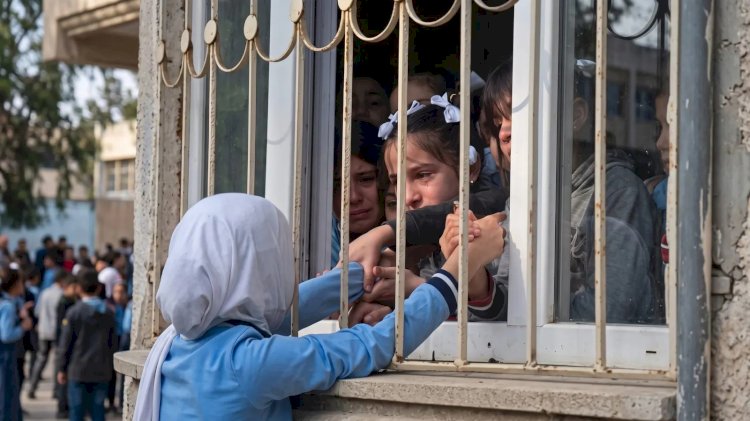
On 12 October 2026, three things happened in Azerbaijan. School administrators began enforcing new uniform rules, turning away girls and teachers who wore headscarves. The Interior Ministry announced that 37 people had been detained after disturbances at schools. And Israel’s President Isaac Herzog met Ilham Aliyev in Baku. Days later, when Herzog spoke at a regional security summit hosted by Azerbaijan, delegations from Turkey, Iran and several other countries walked out.
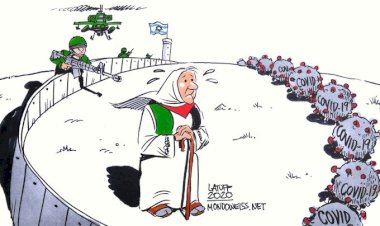
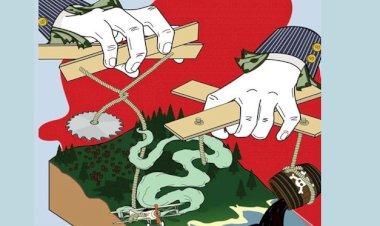
Coincidence does not prove a connection, and a materialist analysis should begin by saying so. There is no evidence that Israel asked for or helped shape the school rules. Their origins lie in domestic legislation, and Baku describes its relationship with Israel as a normal diplomatic partnership. Online cartoons portraying Aliyev as Netanyahu’s puppet (images Israeli media have described as antisemitic) are conspiracy, not analysis.
The more useful question is this: what interests and structures connect a state that bars veiled girls from classrooms with one that sells crude oil to Israel and buys Israeli drones? That is the question this text addresses.
A Decree That Avoids Naming the Hijab
The legal changes began over the summer. A law passed on 7 July 2026 added patriotism and secularism to the principles of general education. On 21 September, the cabinet approved school uniform rules barring clothing deemed inconsistent with the secular character of education. Similar rules for teachers followed on 6 October, and schools began checking compliance on 12 October.
The rules never mention the hijab. Authorities say they are protecting a neutral school environment, where children are not divided by religion or income.
That vagueness serves a purpose. Schools are among the state’s most immediate points of contact with people, and control is easier to impose when it looks like routine procedure. The rules leave headmasters and security staff to decide what “secular” means. That gives the state room to deny responsibility at the top while officials on the ground enforce the policy. When people resist, the police step in.
The Interior Ministry cites attacks on school staff and property, including reports that a school director’s car was burned and that someone tried to set fire to a school. Amnesty International, meanwhile, has documented the detention of peaceful protesters, including a mother protesting her daughter’s exclusion; the disappearance of an activist who tried to organise free online lessons for girls shut out of school; and reports that TikTok and Instagram became inaccessible. Both sets of accounts can be true. Neither supports the government’s claim that the policy is neutral.
A Rentier State with Two Pipelines
Azerbaijan under Aliyev is a classic rentier autocratic state of the Aliyev family. Revenue from oil and gas comes from abroad and is distributed through the Aliyevs. That reduces the ruling group’s need to bargain with society over taxes, and, by extension, over rights. Two material links connect this system to Israel.
The first is oil. Kpler ship-tracking data show that Azerbaijani crude, shipped through the Baku-Tbilisi-Ceyhan pipeline and loaded at Turkey’s Ceyhan, accounted for 46.4 percent of Israel’s oil imports in 2025. That amounted to about 94,000 barrels a day, the largest share Azerbaijan has supplied this decade. Oil Change International, an energy watchdog, estimated that Azerbaijan supplied nearly 40 percent of Israel’s crude between November 2023 and October 2025. It also noted that official documents list these shipments as Turkish because the pipeline ends in Turkey.
The legal opinion accompanying the report argues that supplying Israel while it conducts military operations risks complicity under the Genocide Convention. That conclusion is contested. The shipment volumes, however, are not seriously disputed, and Israel’s energy ministry has declined to comment on its sources.
The second link is arms. SIPRI data show that Israeli weapons made up about 69 percent of Azerbaijan’s major conventional arms imports between 2016 and 2020. Israel’s share had peaked at roughly three-quarters in the mid-2010s. Drones and loitering munitions played a prominent role in Azerbaijan’s 2020 victory in Karabakh, and Azerbaijan’s foreign minister has said Israeli weapons were important to that victory. In 2021, Aliyev was filmed warmly patting an Israeli Harop drone at an arms exhibition.
Taken together, the oil and arms links form a closed circuit. Oil revenue helps build the state’s coercive capacity, which in turn supports the national liberation narrative around Karabakh and helps legitimise the regime. Israel is therefore more than a partner in foreign policy. The relationship is one of the structural supports that gives Aliyev room to govern without relying on popular consent.
For Israel, the relationship revives an older strategic idea. From the 1950s onward, Israeli planners sought ties with non-Arab states on the edges of the Arab world, including Iran under the Shah, Turkey and Ethiopia. The aim was to outflank hostile neighbours. The Iranian Revolution broke one link, and the collapse of Turkish-Israeli relations over Gaza weakened another.
Azerbaijan now offers some of what the doctrine has long sought: a platform near Iran, access for intelligence gathering and a supply of light crude. The two countries share a 428-mile border, and a large Azeri-speaking population lives on the Iranian side. Pro-Israel commentators have described Azerbaijan as strategically useful for reconnaissance.
Whether Azerbaijan has been used in this way remains disputed, but one episode is telling. In June 2025, after the Israel-Iran war, President Pezeshkian asked Aliyev to investigate reports that Israeli drones had entered Iranian airspace through Azerbaijan. According to Iran’s account, Aliyev denied the reports and promised that Azerbaijani territory would not be used against Iran. Azerbaijan’s account of the call omitted the exchange.
Baku opened an embassy in Tel Aviv in 2023, becoming the first Shiite-majority country to do so. Herzog’s visit in October turned that relationship into a public spectacle.
“Secularism” of the Theocratic Israel’s Ally
The two governments also share a political vocabulary. From Theodor Herzl onward, Zionist thinkers have often cast the Jewish state as a European outpost facing Asia. Ehud Barak later condensed that image into the phrase “a villa in the jungle.” Marxist and postcolonial scholars, including Maxime Rodinson and Patrick Wolfe, have argued that this civilisational framing helps legitimise a settler-colonial project by depicting the people it dispossesses as backward. This interpretation is contested, but the political work such language can do is worth examining.
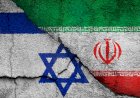
Israel presents itself as a Jewish state, while Iran’s ruling system is grounded in Shiite political authority. Azerbaijan’s relationship with both countries is shaped by regional rivalry, including tensions over Iran’s influence and the position of its large Azeri population. In that context, Baku’s appeal to secularism can serve as a means of countering Iranian influence inside Azerbaijan. The issue, then, is not secularism or religious practice in isolation. It is how states use both amid imperial power relations and regional competition.
From this perspective, Azerbaijan’s school restrictions belong to a broader effort to contain Iran through regional alliances. Israel is a central US ally in the region, and the argument here is that the United States and Israel are seeking to limit Iran’s influence after the setbacks they have suffered in their confrontation with Tehran. Azerbaijan is one part of that effort. Other parts include Turkey’s agreements with regional states under what the passage refers to as the “Mecca agreement,” as well as reported steps to expel Iranian airlines and financial institutions from Turkey. The precise agreements and measures need to be identified to make this account complete. These developments should also be considered alongside the complex regional dynamics surrounding Yemen.
This context helps explain why Baku’s language of secular modernity is politically useful. A government seeking Western and Israeli support can present itself as modern and secular, while casting Iranian influence as a threat. The veiled schoolgirl becomes a symbol of that supposed threat, and her exclusion is presented as proof of the state’s modernity.
Leila Ahmed has documented an earlier colonial use of similar language. In Egypt, Lord Cromer condemned the veil while opposing women’s education and cutting public spending. The rhetoric of women’s liberation helped sustain an order that kept women subordinate. Baku’s policy condenses that contradiction: the state claims to liberate women from the veil, then bars them from the classroom, where their opportunities could actually expand. Lila Abu-Lughod’s critique of the rhetoric of “saving Muslim women” is directly relevant.
The alliance also carries a political cost, and the school restrictions can be read partly as a response to that cost. About 96 percent of Azerbaijanis identify as Muslim. Baku’s partner is a state that South Africa has accused of genocide at the International Court of Justice, a charge Israel denies. Erdoğan has also called Israel’s war in Gaza a genocide.
Azerbaijan’s ruling party says its relationship with Israel is based on international law and mutual interest, and points to Aliyev’s repeated support for a two-state solution. Even so, the alliance creates a gap between the government and the religious sentiments of much of the population. Consent alone cannot close it. The government has to manage it.
One way of doing so is to shift the focus of public anger. When devout people are treated as a security threat, and Turkish criticism is dismissed as foreign interference—Aliyev has told outsiders to keep their noses out of the country’s way of life—the government can recast Muslim solidarity, whether with veiled schoolgirls or Palestinians, as meddling by Iran or Turkey. That is an inference from the pattern, not proof of the government’s intent. Its effect is to turn a problem of political legitimacy into a dispute over national sovereignty.
Who Pays?
Azerbaijan’s school restrictions are presented as a way to curb Iranian influence and Shiite radicalism. But secularism and religious repression can both be imposed from above, as expressions of the ruling class’s political priorities and its need to govern. In practice, measures like these have often produced the opposite of their stated aim: Islamists have been able to turn repression into a political grievance and build support by claiming to defend those who are being excluded.
Turkey’s recent history offers a warning about that kind of backlash. Azerbaijan’s government appears to believe it can settle every conflict through coercion. But suppressing religious expression does not necessarily weaken religious movements. It can give them a stronger claim to legitimacy. But in this political process, girls bear the immediate cost. A girl from a wealthy Baku family who is pushed out of a state school may have alternatives: private education, a tutor or a foreign university. A girl from a poor family in a district town may have none. Without a school certificate, her chances of formal employment narrow. She may become more dependent on male relatives, marry early, take on unpaid care work or enter the informal economy.
Teachers face an ultimatum of their own. Zahra Hasanova told Al Jazeera that wearing a headscarf was her choice, and that deciding to remove it should be hers too. Women who depend on a state salary are effectively told to uncover or lose their jobs. Those most likely to comply are the ones who can least afford to refuse.
Silvia Federici’s Caliban and the Witch offers a useful framework for understanding these consequences. Federici argues that capitalism has long regulated women’s bodies to organise the reproduction of labour. Dress rules are one means of doing so. From the perspective of poorer families, the government’s promise of a classroom where rich and poor stand as equals rings hollow: wealthy girls are unlikely to be the ones shut out.
Ankara and Tehran
Neither of Azerbaijan’s neighbours is an innocent defender of women’s rights. Turkey’s ruling party spent decades fighting the country’s headscarf ban before it was lifted. Now Erdoğan has condemned Azerbaijan’s restrictions in a speech at the United Nations, and his chief adviser has called on Baku to reverse the rules. Pro-government Turkish media have gone further, presenting the policy as a gesture to Israel.
But Ankara, despite formally cutting trade with Israel, allows Azerbaijani crude to travel through its pipeline to the Mediterranean and collects transit fees. Erdoğan praised that same pipeline at Baku Energy Week in 2025. Condemning the restrictions costs little when the oil keeps flowing.
Tehran’s position is no less awkward. The Islamic Republic jails and beats women for removing their headscarves, so it cannot credibly present itself as their defender. Iran’s official response was initially described as muted, even as the dispute opened another front in tensions between Iran and Azerbaijan.
Iranian-aligned networks and Islamist movements could benefit either way: every girl excluded from school becomes a recruitment image. The 2010 ban showed how that can happen. A left that opposes Aliyev’s alliance with Israel must not be drawn into either Ankara’s or Tehran’s camp.
Toward an Internationalist Alternative
The most hopeful response has come from below, not from any government. Students in Baku and Masalli boycotted classes in solidarity with classmates who had been excluded. Secular and devout students participated together, while some teachers began teaching outside the school gates. This is the basis for a politics that rejects both secular authoritarianism and clerical reaction.
The demands follow from the situation: withdraw the uniform rules; release the detained protesters; account for the missing activist; restore access to the internet; and reinstate the excluded teachers. The oil and arms flows that bind Baku to Israel’s war economy also need to be confronted. They help shield Aliyev from accountability to his own population.
Opposing that alliance is a political and economic position, not a communal one. Azerbaijan’s Jewish communities are neighbours and fellow citizens, not targets. And solidarity with Palestinians loses its force when it slips into conspiracy theories.