

NATO 3.0: The New War Order and Erdoğan’s Survival- Derya Koca
 Socialist
Jul 13, 2026 10:51
629
Socialist
Jul 13, 2026 10:51
629
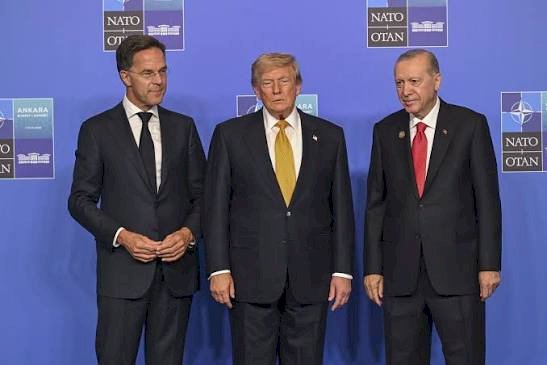
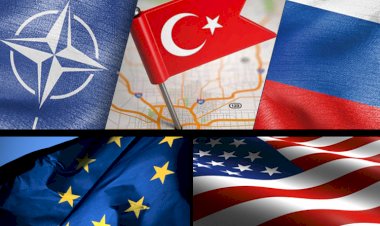
Twenty-two years later, NATO has convened once again in Türkiye. Under the new dynamics created by the historic decline of U.S. hegemony, we are witnessing the resurgence and reorganization of an alliance that was declared "brain dead" in 2019. This new period requires regional sub-imperialist partners such as Erdoğan, as well as a far greater sharing of the burden of expanding military expenditures.
From "Brain Death" to Reorganization
Developments in the international arena since 2019 have enabled NATO to reorganize itself and stage a vigorous comeback. The most significant of these developments has been the war in Ukraine. Through the massive military support provided to Ukraine, the war was effectively brought onto Russian territory. NATO's expansion also continued: North Macedonia joined in 2020, Finland in 2023, and Sweden in 2024. More contentious candidates, such as Bosnia and Herzegovina, Georgia, and Ukraine, remain in the queue.
Presenting the arrival of a hot war on Europe's borders as an urgent political campaign, the European ruling classes have begun reinstating compulsory military service. Conscription has already returned in frontline states such as Denmark, Latvia, and Lithuania. Poland has also placed its reintroduction on the political agenda, while heated debates continue in Germany.
The most important consequence of the war in Ukraine has been its transformation into a process compelling European imperialism to restore internal cohesion and coordination. The same reality was experienced by the United States in a painful way during the war with Iran. Having failed to secure the level of support it expected from European governments on Iran and suffering a political setback, Washington has come to recognize that it has a direct interest in strengthening NATO's internal unity and cohesion.
This does not mean that the interests of the United States and the European powers are fully aligned. Since the outbreak of the Ukraine war, the European Union has been mired in a deepening economic crisis while becoming increasingly dependent in critical areas such as intelligence, energy, and technology. At the same time, European countries continue to maintain extensive trade and investment ties with China. Moreover, the EU lacks the political and economic capacity to implement one of Trump's central demands: severing commercial relations with Beijing. In short, while China has become Washington's primary strategic adversary, it does not occupy the same position in the hierarchy of priorities for the EU.
The fact that China controls 57 of the world's 65 critical technologies has created new forms of dependence and technological superiority, making this one of NATO's central concerns. Cooperation among Western powers in fields such as artificial intelligence, semiconductor production, and space technologies has therefore emerged as a major strategic priority, a point explicitly reflected in NATO's declaration. The declaration states:
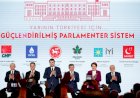
"Today in Ankara, we are announcing more than $50 billion in new defence procurement; we commit to expanding joint production capacity and accelerating innovation through closer cooperation with industry. We will continue removing barriers to defence trade among Allies and make full use of NATO partnerships to maximize defence industrial cooperation and production capacity."
In other words, NATO is emphasizing that deterrence will increasingly depend on high-technology military capabilities and on large-scale investments in these sectors.
In short, these developments are compelling the Western bloc to function with greater cohesion and to act collectively.
Alliance with Sub-Imperialist Powers
NATO's legitimacy during the Cold War rested on defending the world order against what it called the "communist threat" and, ultimately, against the revolutionary challenge of the working class. Today, however, the central objective of imperialism is the containment of China and the reconfiguration of regions such as Latin America and the Middle East. In Iraq and Syria, regimes were overthrown at the cost of millions of lives, and the region was reshaped on the basis of Israel's unquestioned supremacy. In Venezuela, Maduro was abducted. Cuba remains under a brutal blockade. In the Middle East, U.S. imperialism will continue its aggression to secure the subjugation of Iran, the last major link remaining from the contradictory legacy of the previous century. Immediately after the NATO summit declaration was released, Trump gave another order to bomb Iran when he was still in Ankara.
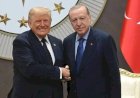
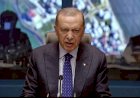
Regional restructuring requires regional actors capable of carrying it out. As NATO's southern front, Türkiye occupies a strategic position linking the Europe to the major flashpoints in Iran, Ukraine, and the Black Sea. Donald Trump's remark that he had "come for Erdoğan" was therefore far more than a routine diplomatic gesture. The relationship reflects mutual strategic interests. Washington no longer wants to wage its regional wars alone. Instead, it seeks a model in which the financial and military burden is shared with its allies while regional partners assume greater initiative. Erdoğan, fully aware of the advantages this presents for Türkiye's own sub-imperialist ambitions, is seeking to extract the maximum possible strategic, commercial, military, and political gains from the process.
Having faithfully fulfilled the roles assigned to it, Türkiye significantly strengthened Zionist states’ position by enabling the supply of energy, fuel, military materials, and intelligence from its military bases while Palestinians were being subjected to genocide. Indeed, as soon as the NATO Summit began, Erdoğan reaffirmed Türkiye's continued support for Ukraine.
In return, Trump announced that the CAATSA sanctions would be lifted. Erdoğan's visible satisfaction with the announcement was striking. Shortly before the summit, the Halkbank case, which was linked to the alleged circumvention of sanctions on Iran and implicated individuals close to Erdoğan, was dismissed. Images of Trump warmly praising Erdoğan were broadcast for days on Turkish televisions. At the same time, the issues of the Russian-made S-400 missile systems purchased by Türkiye but never activated, and the F-35 fighter jets that Türkiye paid for but never received, remain unresolved. Washington has yet to take a definitive step, largely because Israel continues to oppose congressional approval of the F-35 decision.
The rules-based international order established after the Second World War has long since given way to an era in which power alone determines outcomes. As Trump reallocates military resources to strategic regions in pursuit of containing China, he is increasingly dependent on the support of regional allies. Through this strategy, Washington aims to offset China's long-established dominance in manufacturing and advanced technology with the military superiority that the United States still possesses.
Türkiye's Ruling Class Is Pro-NATO
Türkiye's ruling class has historically been pro-NATO and pro-US. This orientation is by no means unique to Erdoğan. Nor has the Islamist political tradition he represents ever broken with this strategic alignment. Despite the anti-Israeli rhetoric that dominates domestic politics today, Erdoğan sought to turn the NATO Summit into a major spectacle designed to generate international legitimacy and economic support, thereby compensating for his growing political weakness at home.
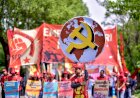
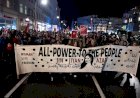
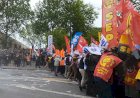
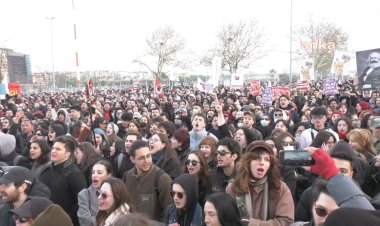
One component of this spectacle was an intense campaign of repression that resulted in the imprisonment of hundreds of socialists. To silence anti-NATO voices, all demonstrations and meetings were banned in Ankara for thirteen days. Homes were raided in dawn operations across dozens of cities across Turkey, and police launched operations targeting socialists, trade unionists, journalists, academics, and left-wing activists involved in anti-NATO campaigning. Hundreds of people were detained and arrested. The repression extended from a young socialist comedian to elderly environmental activists.
As part of these de facto martial law measures, the homes of SEP members were raided in three different cities. After being held for days on accusations of membership in an illegal armed organization, three members were released under judicial supervision, requiring them to report to a police station five days a week, while another SEP member was imprisoned. Hundreds of people still remain behind bars.
Erdoğan deeply fears the socialists who are organizing workers and youth. The country is experiencing severe impoverishment alongside mounting social anger. Two years ago, a politically dynamic younger generation launched a massive wave of protests and resisted the government's efforts to crush the opposition. Yet for Erdoğan, who hopes to secure future electoral victories by suppressing the bourgeois opposition and eliminating political rivals, the strategic priority is the repression of the working class. Under the pressure of the economic crisis, wages have been continuously eroded in real terms, fueling widespread public discontent. For more than a decade, not a single major industrial strike in Türkiye has been allowed to proceed without state intervention. Under these conditions, Erdoğan seeks salvation through strong international backing, aiming not so much to strengthen his own domestic position as to weaken his opponents and thereby continue ruling as an elected autocrat.
Following the wave of repression carried out under the pretext of the NATO Summit, there are widespread expectations that Erdoğan will launch yet another major operation against the leader of the main opposition, Özgür Özel. Yet Özel, whose party has itself become the target of this authoritarian offensive, presents himself as a more reliable NATO ally than Erdoğan. His criticism of the summit is directed not at NATO's war plans, but at the fact that "the NATO Summit is taking place while the presidential candidate is imprisoned." His message is unmistakable: "I can be a more reliable, more stable, and more predictable partner for imperialism."
An interview given by Rahmi Koç on the occasion of the centenary of Koç Holding, Türkiye's largest capitalist, illustrates the close alignment between the AKP's ambitions to become a regional power and NATO's broader strategic orientation. These ambitions include expanding Türkiye's influence throughout the Middle East and profiting from the reconstruction of Palestine and Syria.
"In today's world, if you have power, your voice is heard; if you don't, it isn't. The framework established by the United Nations has effectively collapsed. The changes are remarkable. Every country is being dealt a new hand of cards, and you have to play accordingly. Türkiye has many strengths: we are surrounded by seas on three sides, we occupy a strategic location, we enjoy four seasons, we have fertile land and a young population. Most importantly, we know how to operate on slippery ground. In the coming years, we must make full use of all our strengths. This is the era of 'your voice carries only as far as your power.'"
For the Turkish bourgeoisie, as for Trump and Western imperialism as a whole, Erdoğan's efforts to reshape the political regime promise nothing more than a quieter and more stable country. At a time when repression is steadily intensifying in Türkiye, the historical bankruptcy of the bourgeois opposition, which looks to the European powers for salvation, only reinforces the conclusion that working people have no alternative but to wage their own independent class struggle, even in defense of basic democratic rights and freedoms. A bourgeois opposition whose political horizon never extends beyond the ruling elites of the United States and the European Union ultimately becomes one of Erdoğan's greatest sources of strength.
The Anti-Imperialist Athens Conference
The revolutionary forces confronting internationally organized capitalism and imperialism are, unfortunately, in a profound crisis both in Türkiye and globally. Yet war also signifies the deepening of existing contradictions and the emergence of new opportunities for revolutionaries.
The expansion of military budgets means, and will continue to mean, deep cuts to public spending on education, healthcare, and other essential services across every country, accompanied by intensified attacks on the working class. The "Rearm Europe" campaign launched by the European Union will find its counterpart in Türkiye through the deepening of austerity policies. Every additional dollar allocated to tanks and weapons will be taken from hospitals, schools, wages, and pensions. This points to a new and deeply contradictory period in which governments are compelled to wage war first and foremost against their own working classes.
The only social force capable of halting this war machine is the international working class. The answer is not to choose one imperialist bloc over another, but to build class struggle against war on the basis of an internationalist socialist program. Lasting peace will emerge from the united struggle of workers resisting rearmament across the world. The only adequate response to capitalism's attempt to resolve its historic crisis through war is to expand the international socialist movement capable of abolishing the capitalist system itself.
For this reason, the international conference that will bring together the revolutionary forces of the world's working class in Athens from 22 to 25 July against imperialist war, exploitation, and rising authoritarianism assumes even greater significance. SEP will take its place in this historic struggle.
- Türkiye must withdraw from NATO. NATO must be dissolved.
- All NATO bases, beginning with Kürecik and İncirlik, must be closed.
- All relations with Israel must be stopped.
- Military spending must be redirected to education, healthcare, and the needs of working people.