

Colombia After Venezuela: An Interview with Revolutionary Marxist Jerson Reyes
 Socialist
Jan 8, 2026 12:09
1584
Socialist
Jan 8, 2026 12:09
1584
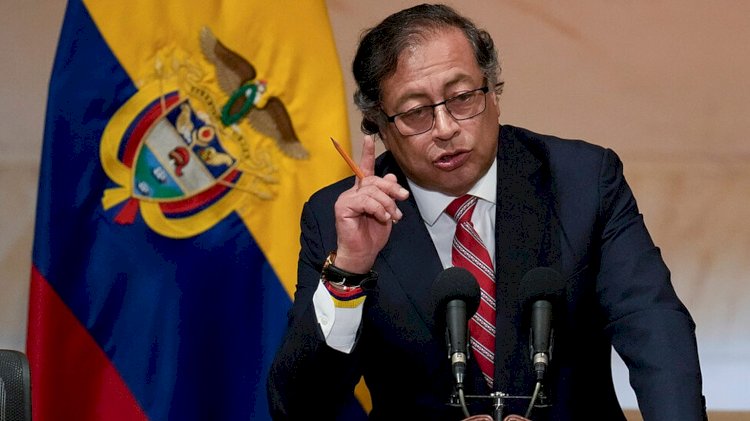
We spoke with Revolutionary Marxist Jerson Reyes about the situation in Colombia following the events in Venezuela. Following the abduction of Venezuelan President Nicolas Maduro by U.S. imperialism, Colombia is also among the countries targeted by the Trump administration. We discussed the latest situation in the country with Jerson Reyes from the Marxist Studies Seedbed.
Following the abduction of Nicolás Maduro from Venezuela, Donald Trump made threats against Colombia and personally insulted Colombian President Gustavo Petro, calling him a "sick man" and implying that an operation would be conducted against Colombia. At this critical moment, what is your analysis regarding Gustavo Petro's current public support? To what extent does this external threat unite Colombians around the government?
Since our previous governments always acted according to North American interests, Colombia has not faced such a direct threat of military intervention in its recent history. Now, the positions of different social and political sectors in the country are beginning to become visible.
The Petro government has recently implemented a series of social reforms and provided specific benefits to the working class; these include significant increases in the minimum wage, financial reform in public higher education, progress in land restitution and agricultural policy, reductions in the salaries of members of Congress, and pension and labor reforms, alongside steps taken on a series of symbolic issues. Petro’s foreign policy has not only created an impact in the region but also enjoys considerable popular support.
This translates to support both in the streets and at the ballot box in potential mobilization scenarios for Petro. For this reason, significant support is expected for the national action call Petro made for January 7 (today), which is already backed by social organizations as well as labor and teacher confederations.
The lack of legitimacy regarding what happened in Venezuela and the threats against Petro among the masses and a large portion of intellectuals has led to serious support for the government.
On the other hand, the Colombian right is acting very cautiously; they understand that the current situation has changed the dynamics of the game and will have significant effects on the elections to be held in May, and they are calling for the defense of democratic legitimacy while ostensibly rejecting a possible intervention. The right is very cautious because they foresee that an intervention would carry the reformist left back to the presidency. Conversely, there have been right-wing sectors calling for direct intervention, but they have not received significant support. In my opinion, the government has serious support, and this is expected to be reflected in the protests taking place starting from January 7.
Colombia was governed for many years by a strong, pro-American right wing. Given the current tensions with the U.S., what is the potential for political and military cooperation between these traditional elites and the Trump administration? Do you foresee a risk of internal instability?
Specifically, while it is impossible to rule out military intervention—not only because the U.S. has cast aside so-called international law but because of its colonialist policy trying to realign Latin America with its own interests—I believe the Colombian scenario is different from the Venezuelan one. The fact that the Petro government came to power through free elections and that we are on the verge of upcoming elections leads the Colombian right to align itself with Trump under different mechanisms regarding the elections. Trump will try to intervene in the election process using different tools; he is not only deepening the media attacks against Petro but also conditioning presidential candidacies.
Therefore, I do not see internal instability as an imminent possibility. The Colombian bourgeoisie, unlike the Venezuelan bourgeoisie, is organized. Although the Colombian bourgeoisie is already worn out and it is unclear which block they will enter the elections as, they will work closely with Trump during the election process. We can say that Petro has implemented a series of reforms in the upper echelons of the military and improved conditions for soldiers at all levels, which has gained him significant legitimacy within the armed forces. But one can never speak with certainty regarding the loyalty or disobedience of military forces.
The Colombian bourgeoisie will want to exploit the situation in Venezuela and deepen the polarization within the country. To do this, while making careful public statements, they will try to bring their own politicians back to power through elections by negotiating with Trump behind the scenes.
What is the status of the revolutionary socialist movement and the class struggle in the country?
Compared to the uprising processes in 2021, I can say that street struggles have decreased considerably. At the end of that process, as in similar examples in Latin America, Gustavo Petro came to power as a reformist leftist leader. Since the arrival of the Petro government, a large portion of social opposition leaders have become institutionalized by integrating into the system. These organizations have been reduced to extensions of the election efforts of Gustavo Petro and his party. On the side of revolutionary organizations, there is a considerable level of marginality. They are inadequate in adapting and positioning a proletarian policy that would allow them to gain ground in areas where the government falls short. It should be known that there is a historical problem in the Colombian socialist movement of not being proletarian-centered.
In the current situation in Colombia, I can say that the main axis of the political struggle is taking place between the current reformist leftist leadership and the pro-U.S. Colombian right-wing forces. Finally, I want to say a few words about the so-called revolutionary organizations that have adapted to the government and speak of international law. These international organizations and laws have always been on the side of the strong, and in reality, calling for respect for this is equivalent to understanding nothing of history and the class struggle. The absence of a proletarian line that would provide a revolutionary solution to the crisis further aggravates the situation in Latin American countries.