

Inside Iran: “This struggle requires international socialist solidarity, class perspective, and historical patience”
 Socialist
Jan 27, 2026 05:59
1395
Socialist
Jan 27, 2026 05:59
1395
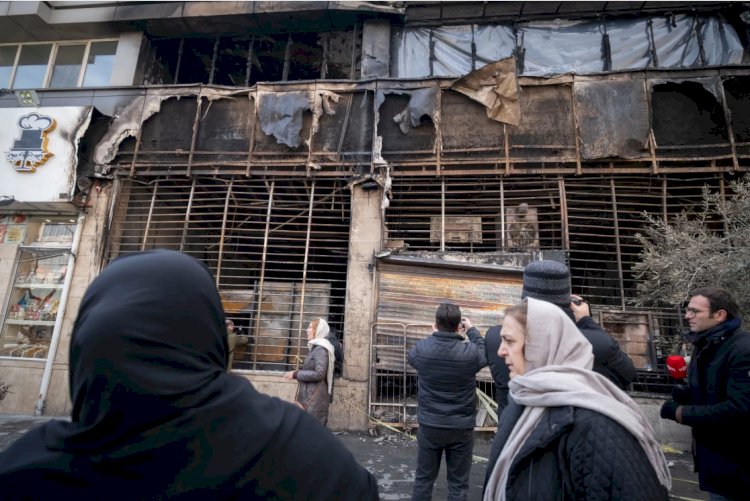
We spoke with Nida Kaveh, whom Socialist Middle East previously interviewed regarding the protests starting in Iran, about the latest situation in Iran following days of a terrible massacre and cut-off internet access. Kaveh conveyed realistic figures, the state of the Iranian streets, and critical details regarding the status of the government:
Socialist Middle East: Let's begin with a great tribute to the immense courage of the Iranian people. We commemorate those who were massacred with deep respect. In our interview on January 25th, the protests had not yet spread to Tehran and Tabriz, and the masses had not yet taken to the streets in major cities. Since then, we lost internet connection with you as well. What happened? Information pollution, manipulation, and truth became indistinguishable. Could you talk a little about the mass dimension of the actions, the violence and suppression experienced, the scope of events, and their political content? How did events unfold?
Nida Kaveh: First of all, one must commemorate the courage of the Iranian people without romanticizing it, but also without underestimating it. This was neither a "spontaneous rebellion that exploded all of a sudden" nor an "operation orchestrated by foreign powers." The process is the expression of an accumulation of structural crises. In the first days, the actions started in the Tehran Bazaar or were very peripheral, based on economic and local injustices. However, in a short time—especially along the Tehran, Tabriz, Kermanshah, Ahvaz, and Mashhad line—the regime's naked violence changed the character of the movement. They tried to silence the protests with internet cuts, massacres, targeted arrests, and the use of snipers.
Attempts were made to make the horror less visible from the outside, but protests had engulfed almost the entire country. The important thing is this: The actions did not proceed as a "public square movement," but as a multi-centered and continuous civil disobedience. As the state cracked down, the actions retreated; as they retreated, they took new forms. The regime did not completely lose control, but social consent was severely eroded.
Socialist Middle East: There were major discrepancies between different sources regarding the numbers said to be killed in the protests. Numbers ranging widely from 30,000 to 3,000 are being mentioned. Can you draw us a realistic picture? What is the situation?
Nida Kaveh: The left needs to be careful on this point. Figures like 30,000 are the product of political agitation; 3,000 is a more conservative but still terrifying estimate. The realistic picture is this: Those killed directly in street clashes are at the level of a few thousand, but regime forces also raided hospitals and killed activists who were wounded in the streets and under treatment. Along with this, the picture took on an even more horrific state. The world also witnessed images of the dead bodies of those kidnapped from hospitals and executed.
Of course, in this extraordinary environment, old scenarios are also being used; for example, those who died during torture in prisons, deaths staged as "suicide," and disappearances: undocumented but numbering in the hundreds. These were just the parts related to deaths. There are also the missing. There are thousands missing. There are people whose whereabouts we do not know. The Iranian state does not provide numbers. There is no independent verification, and there is an internet blackout. Therefore, quality becomes more important than quantity: The state has used systematic and continuous lethal violence against its own citizens.
Socialist Middle East: The regime announced that executions have been temporarily suspended. Is this really the case?
Nida Kaveh: No. This is an old tactical maneuver. Even if the Iranian regime slows down executions temporarily, it accelerates them again when international pressure decreases, or carries out the executions by shifting the files to headings like "drugs" or "national security." This is the regime's classic crisis management. The threat of execution is still used as a disciplinary mechanism.
Socialist Middle East: How many people are arrested? Is there any news from the prisons?
Nida Kaveh: The number of detainees is not clear; we can express it in the tens of thousands. However, what is more critical is this: A significant portion of the detainees are held without trial, and access to lawyers is limited. Prisons function as centers of death and intimidation, especially for the youth. This situation has led to the protests going underground rather than dying out.
Socialist Middle East: So, are the actions completely over? How is daily life? Are shops open, has life returned to "normal"? What is the tension like on the streets?
Nida Kaveh: The concept of "normal" here is an ideological illusion. Shops are open. Schools are operating. The state apparatus is functioning. But there is a silent tension on the street and constant political conversation in communities. This shows that a suppressed but unresolved crisis continues. The regime is still in power but is not hegemonic.
Socialist Middle East: What stage are the strikes in the oil and mining sectors at? Are they continuing, or have they ended? How do you view the possibility of a class reflex maturing?
Nida Kaveh: This is the key point. Strikes in the oil and mining sectors: They did not turn into a full general strike. But the possibility the regime fears most is here. The problem is this: The working class in Iran is angry but organizationally fragmented. Unions are suppressed, leftist cadres are either in exile, in prison, or have withdrawn into seclusion. Therefore, there is a class reflex, but it has not yet turned into a political subject. The potential exists; maturation depends on time and organization.
Socialist Middle East: Is the ruling class able to act as a unified whole within itself? Do you think there is a possibility of a rupture between the army and the regime, or of the mullah regime abandoning Khamenei to protect its gains and make a deal with the US?
Nida Kaveh: No, we cannot say the ruling class maintains its integrity, but a rupture has not occurred either. Uncertainty, the lack of clarity regarding the post-regime scenario, and the issue of political alternatives are also problems for the ruling class. There are conflicts of interest between the Revolutionary Guards, the mullah class, and capitalist factions. However, they all know that the collapse of the current order would be their end. Post-Khamenei scenarios are being discussed, but this is not being discussed in the form of a democratic opening. It is more in the form of a search for consensus among elites to restore the regime. Focused on saving the regime and its gains by making a deal with the US.
Socialist Middle East: Almost every night, international intelligence information or insider information spreads that the US will conduct an operation. It is said that there is a small disagreement between Israel and the US in this situation and that the intervention has been postponed for now. What is being discussed inside?
Nida Kaveh: There are two reactions to these rumors inside: One side waits with hope (this is psychologically understandable but politically very dangerous). A broad segment is rightfully suspicious. Moreover, even if the justification put forward by imperialism for the attack is to topple the regime, US and Israeli intervention would serve to legitimize the regime's nationalist and securitarian rhetoric and even prolong the regime's life, rather than weakening it; it would cause the street movement and the people to retreat. Imperialism is the enemy of the Iranian people in every respect. That is why the most conscious segments of the social opposition in Iran are openly distant from foreign intervention.
Socialist Middle East: So, how do you think this knot will be untied? What will happen in the short term?
Nida Kaveh: In the short term, the regime survives, repression continues. Protests come back in waves. In the long term, the issue is this: Either the Iranian working class and lower classes establish their own independent political line, or crises are postponed with authoritarian restorations. This is not an "overnight revolution" process; it is a continuous, long, painful, and class-based struggle; Iranian history is the best proof of what I am saying.
Socialist Middle East: Thank you very much for the interview. We accept the burden of this great massacre suffered by the Iranian people as our own. We believe most deeply that the Iranian people are strong enough to create a country without shahs, mullahs, exploitative capitalists, or imperialist bandits. Our solidarity is with you.
Nida Kaveh: Finally, it must be stated clearly: The Iranian people need neither the Shah, nor the mullah, nor domestic capital, nor imperialist saviors. Not emotional agitation, but political clarity is required. Solidarity happens not by distorting the truth, but by bearing the weight of the truth.