
The Taliban’s Deepening Tyranny and the Escalating Humanitarian Crisis in Afghanistan - Laila Safi
 Socialist
Jun 17, 2026 09:05
548
Socialist
Jun 17, 2026 09:05
548
It has been nearly five years since the Taliban returned to power in Afghanistan. Over the course of these five years, they transformed discrimination against women from a series of individual prohibitions into a state policy and began enforcing it through armed religious authorities.
They first made the hijab compulsory. They then banned girls from attending middle school, high school, and university; prevented women from working in most state institutions and civil society organizations; barred women from parks, sports facilities, and public bathhouses; and gradually pushed them out of public life. With the Promotion of Virtue and Prevention of Vice Law enacted in 2024, they granted the morality police broad powers to monitor women's clothing, movement, and conduct in public spaces.[1]
Today, Afghanistan is the only country in the world where girls are prohibited from receiving an education beyond primary school. According to UNICEF data, more than 2.2 million girls have been deprived of secondary education. If these restrictions remain in place, that number is expected to exceed 4 million within the next few years.[2]
Expanding Control Through Violence
Herat has become the latest target of the Taliban’s steadily expanding morality enforcement campaign.
Located on the Iranian border, the city has strong historical, cultural, and linguistic ties with Iran. Thousands of Afghan families lived in Iran for decades, and a significant portion of today’s younger generation was born, educated, and raised there before returning to Afghanistan.
Following Iran’s recent mass deportation operations, thousands of Afghan migrants have returned to Herat. Many of these people grew up in a society where, despite numerous restrictions, women were still able to attend school, pursue higher education, work, and participate in everyday social life. They are now returning to a country where women are legally excluded from education, employment, and public life.
The Taliban is fully aware of Herat’s social fabric. It knows that a substantial portion of the local population has experienced different ways of life and has developed cultural ties with Iran that are stronger than those associated with the lifestyle the Taliban seeks to impose. For this reason, the operation launched in Herat is not merely an effort to enforce moral regulations; it constitutes a clear demonstration of power aimed at establishing absolute control over the streets, marketplaces, and all public spaces where people conduct their daily lives.
The Morality Operation in Herat
The operation being carried out in Herat has gone far beyond the policing of dress codes.
Women wearing traditional Iranian-style headscarves are being detained. Footage recorded and shared on social media by local residents shows that even women wearing black chadors and face veils have become targets of Taliban patrols. Full compliance with the Taliban’s own imposed dress regulations is no longer sufficient to protect women from detention or violence.
According to reports by the United Nations Assistance Mission in Afghanistan (UNAMA), officials from the Ministry for the Promotion of Virtue and Prevention of Vice are conducting large-scale operations against women on the grounds that they have violated mandatory dress codes.[1] Witnesses report that morality police stop women in marketplaces, cordon off shopping districts, forcibly load women into vehicles, and transport them to detention facilities without any judicial process.
Footage shared by local residents shows Taliban personnel securing marketplaces and major intersections with pickup trucks, armored vehicles, and heavy weaponry. The recordings show civilians fleeing through rows of shops, women attempting to avoid patrols, and Taliban fighters using weapons during the operation. The scale of the operation resembles a military campaign directed against a civilian population far more than a routine policing measure. When considered alongside UNAMA reporting, the footage provides a clear picture of the scope of the operation.[3]
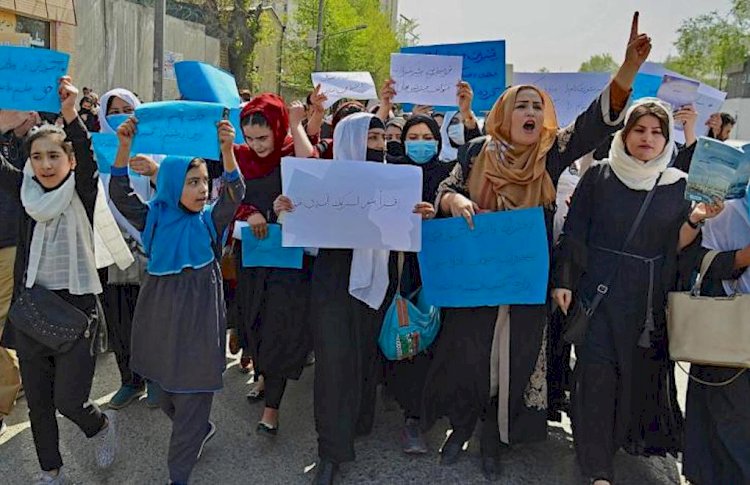
These detentions quickly gave rise to protests.
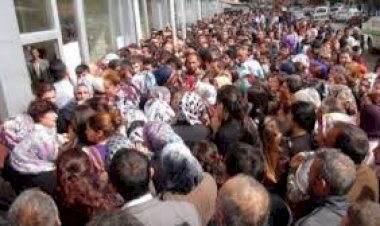
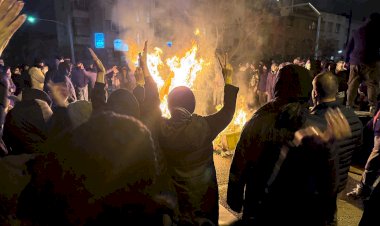
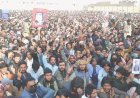
Demonstrators took to the streets under the slogan “Education, Work, Freedom,” demanding the restoration of women’s rights. Before protesters could gather, however, the Taliban deployed armored vehicles, military trucks, and heavily armed units to numerous locations across Herat. According to UN reports and witness accounts, Taliban forces responded to the demonstrations with live ammunition. At least two civilians, including one child, were killed, and more than twenty others were injured.[3]
International Normalization
As repression continues to intensify in Afghanistan, the Taliban is increasingly being accepted as a legitimate interlocutor on the international stage.
European countries and regional actors are holding regular meetings with Taliban representatives on issues such as migration management, border security, and regional stability. Although official rhetoric insists that these contacts “do not constitute recognition,” the reality that emerges in practice tells a different story.
A government that has barred girls from schools, driven women out of the workforce, and effectively criminalized their presence in public life now sits at the same table as governments that define themselves as defenders of democracy and human rights.
European governments continue to negotiate refugee return agreements with a regime that has legally excluded millions of Afghan women from education, employment, and public life. Humanitarian assistance may be a separate matter, but political normalization is a distinct choice. Every official meeting creates a new space of legitimacy for a Taliban administration that continues to expand its policies of repression with each passing day.
Humanitarian Collapse
Political repression and economic collapse have now become two mutually reinforcing phenomena.
According to the United Nations Office for the Coordination of Humanitarian Affairs (OCHA), approximately 23 million Afghans, nearly half of the country’s population, are in need of humanitarian assistance.[4] Around 17.4 million people are facing acute food insecurity, and millions do not know where their next meal will come from.[4]
More than 3.7 million children are currently out of school. Of these, more than 2.2 million are girls who have been barred from attending secondary education.[2] While Taliban policies continue to exclude women from state institutions, civil society organizations, and much of the formal economy, they are also eliminating the last remaining sources of stable income for countless families.[5]
The consequences of the crisis extend far beyond education and employment.
Afghanistan already has one of the highest maternal mortality rates in the world. According to UNFPA data, a woman dies every two hours in the country from preventable pregnancy or childbirth-related complications. Only around 10 percent of women have access to basic healthcare services.[6] Researchers warn that if restrictions on women’s education and participation in the health sector continue, maternal and neonatal mortality rates will rise, reversing health gains that have taken years to achieve.[7]
Each new restriction brings with it a new layer of social devastation. Women lose their jobs, families lose their livelihoods, girls are cut off from education, the healthcare system weakens, and poverty becomes even more deeply entrenched.
References
[1] United Nations Assistance Mission in Afghanistan (UNAMA)
Report on the Implementation, Enforcement and Impact of the Promotion of Virtue and Prevention of Vice Law (10 April 2025)
https://unama.unmissions.org/report-implementation-enforcement-and-impact-pvpv-law-afghanistan
English PDF version:
https://unama.unmissions.org/node/100083631
[2] UNICEF – Afghanistan Education Updates
https://www.unicef.org/afghanistan
[3] Reuters / UNAMA – Morality Operation and Protests in Herat (June 2026)
UN: Taliban Detaining Women in Herat for Alleged Violations of Hijab Rules
https://www.reuters.com/world/asia-pacific/un-says-taliban-arrest-30-women-violating-hijab-rules-afghanistan-2026-06-12/
[4] United Nations Office for the Coordination of Humanitarian Affairs (OCHA)
Afghanistan Humanitarian Needs and Response Plan
https://www.unocha.org/afghanistan
[5] Human Rights Watch – Afghanistan, World Report
2026 Report: https://www.hrw.org/world-report/2026/country-chapters/afghanistan
2025 Report: https://www.hrw.org/world-report/2025/country-chapters/afghanistan
[6] UNFPA Afghanistan – Maternal Health and Access to Healthcare Services
https://afghanistan.unfpa.org
[7] Maruf et al.
“The Potential Impact of Improvements in Maternal and Newborn Health in Afghanistan on Mortality Rates Through 2030,” Maternal and Child Health Journal (2025)
https://link.springer.com/article/10.1007/s10995-025-04108-4
Visual Documentation
The videos and photographs used in this article concerning the morality operation, military deployment, and protests in Herat are based on eyewitness recordings captured by local residents and shared via social media platforms.
As independently verifiable metadata could not be obtained for every image and video, these materials have not been treated as conclusive evidence on their own. Rather, they have been used as visual documentation of the reported events and referenced only after being cross-checked against credible sources, particularly reporting by UNAMA and Reuters.