

The State of the World as We Enter 2026 – V. U. Arslan
 Socialist
Dec 31, 2025 06:12
3397
Socialist
Dec 31, 2025 06:12
3397
Entering 2026, the state of the world can be summarized under the following headings:
The “Magnificent Seven” and the Impoverishment of Hundreds of Millions:
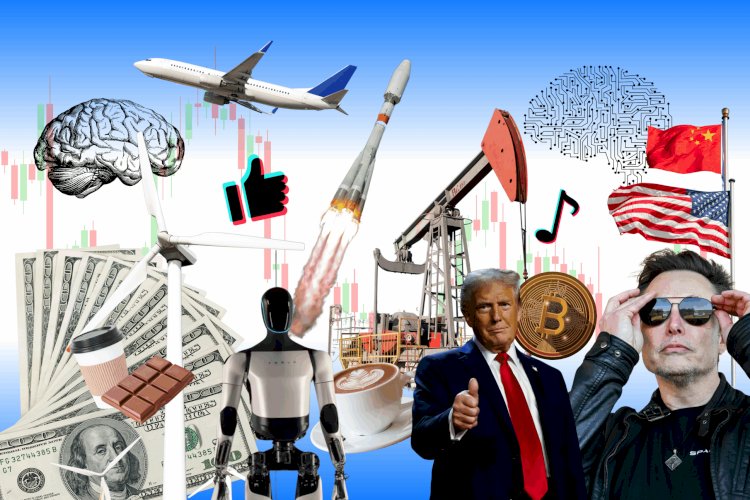
Global capitalism today stands at the center of a structural impasse produced by low growth and high inflation (stagflation). At the same time, financial markets are experiencing an “artificial intelligence intoxication” that is completely detached from this reality. While the world economy is sending clear signals of stagnation, the massive concentrations of capital piling up around the so-called “Magnificent Seven” (Nvidia, Apple, Microsoft, Alphabet, Amazon, Meta, Tesla) which are propping up U.S. stock markets, have given rise to one of the largest economic bubbles in history, fueled not by real profitability but by technological speculation about the future. Technology giants with market capitalizations exceeding trillions of dollars are being marketed as “saviors” capable of unclogging the system’s blocked arteries. Yet once this stock market bubble bursts, it will inevitably trigger a devastating economic collapse. Already, the gap between grotesquely inflated share prices and the real purchasing power of working people has reached staggering proportions. Any potential crash will make a major class confrontation unavoidable.
Resistance and Hope:
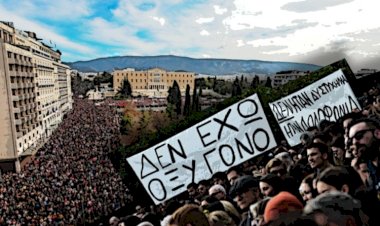
Against the regime of poverty, precarity, and corruption imposed by capital on working people, uprisings erupted in many countries throughout 2025. From the United States to Britain, from Argentina to France, the working class organized a determined struggle against the soaring cost of living and social devastation. The leading role played in these struggles by workers in sectors that sit at the nerve centers of modern capitalism which are logistics, software, and high technology, has carried the class’s power derived from production onto a new plane. In particular, a new generation of youth in Western metropolises, increasingly drawn to revolutionary socialist ideas, is transforming this objective anger into ideological consciousness and organization. It must not be forgotten that democratic rights, lasting peace, and economic gains can only be secured through the proletariat’s complete break from bourgeois blocs and its independent political action. To prevent spontaneously emerging mass movements from being absorbed within the capitalist order, the construction of an internationalist revolutionary leadership has today become a matter of life and death for humanity.
A Time of Severe Geopolitical Instability: As the world enters 2026, it is facing a period of severe geopolitical instability driven by the breakdown of neoliberal globalization. The familiar rhetoric of “free markets” and “globalization” is rapidly giving way to a more protectionist and militarized language centered on “national interest,” “economic security,” and “technological dominance” that is a shift clearly captured by the slogan “America First.” To the extent that the steady decline of U.S. imperialism and, conversely, the steady rise of China continue to shake the imperialist hierarchy, economic nationalism will persist in gaining strength.
At the same time, cracks are appearing in capital’s global spatial strategy. The profit strategy that once moved production to Asia in search of efficiency and cheap labor is now being steadily abandoned. The new strategy is a form of nationalist economic fortification aimed at bringing production back to imperial centers or relocating it to so-called “friendly” geographies through “friend-shoring,” while insulating supply chains from geopolitical risks.
The Return of the State as the Architect of Capitalist Production:
The state is no longer merely an apparatus operating behind the scenes of the market mechanism. It is increasingly assuming the role of a direct architect of capital accumulation. Whereas during the neoliberal era the state functioned primarily as a force guaranteeing the unhindered circulation of capital, today it has become a decision-making center that actively shapes industrial policy, subsidizes strategic sectors, and intertwines with technology capital. Major technology corporations are now defined as integral components of the “national interest.”
The Rise of Economic Nationalism Goes Hand in Hand with the Rise of Authoritarianism and the Far Right:
Tariff barriers and protectionism are only possible through a strong and interventionist state apparatus. This dynamic inevitably fuels authoritarianism. This process is unfolding across the globe. The far right enters the scene here as a functional political tool, redirecting the anger of the working class away from capital and toward migrants, other nations, or so-called “internal enemies.” At the same time, as strategic technology firms increasingly become extensions of the state, the vast data and surveillance capacities they control are being integrated into the state’s coercive apparatus. China stands as a model case in this regard. While democratic backsliding is taking place in Europe which is the historic cradle of bourgeois democracy, the Trump administration is actively seeking to bring far-right parties to power across Europe.
The Decline of the United States Will Unfold in Slow Motion:
The relative decline of U.S. hegemony is structurally different from the British case at the beginning of the twentieth century. Owing to the dollar’s status as the global reserve currency, its control over international financial networks, and its vast military-technological capacity, the United States possesses a far deeper form of “hegemonic resilience” than Britain ever did. For this reason, the erosion of U.S. hegemony will not take the form of a sudden collapse but rather unfold as a turbulent and protracted process stretching over time.
There Are Clear Limits to China’s “Asymmetric” Rise:
While China, as an economic powerhouse, is challenging the imperialist hierarchy, it still lags far behind the United States in terms of military capacity, diplomatic networks, and ideological and cultural hegemony. China’s muted response in the face of U.S.-Israeli attacks on Iran being one of its most critical energy suppliers and strategic partner, clearly exposes the imbalance between its status as an “economic giant” and its limited “global hegemonic capacity.” A similar pattern can be observed in the case of Venezuela. Although China has emerged as a global actor in terms of capital export and control over raw materials, it has yet to acquire the capacities of “armed protection” and “the imposition of global order” that are indispensable to becoming a dominant imperial power.
Trump’s Gaze from Alaska to Venezuela, from the Panama Canal to Ukraine’s Resources:
For the ruling classes, militarism is not merely a political choice but a strategy for escaping the spiral of low growth and stagflation confronting capital. When the capitalist mode of production hits a dead end within domestic markets, it is compelled to seek new sources of raw materials, energy corridors, and market spaces in order to realize surplus value. Imperialist aggression is thus a necessary outcome of this economic contraction. Military spending constitutes an “ideal” market for capitalism. It is because military commodities do not return to the market to intensify competition; instead, they are purchased by the state and destroyed in war. This provides a temporary but vital lifeline for capital accumulation.
The Third World War and the Nuclear Threshold:
The increasing militarization of competition among imperialist powers is bringing the prospect of a Third World War onto the agenda. Although the possibility of nuclear catastrophe remains a deterrent for the competing powers, it is difficult to give a clear answer to how long this deterrence can remain effective. The very possibility of a nuclear world war reveals the extent to which the imperialist-capitalist system is capable of sacrificing all of humanity and the planet itself for the sake of its own survival. At the same time, as seen in the cases of Ukraine and Iran, the ruling classes are recklessly deepening conventional wars while remaining below the nuclear threshold, condemning millions of working people to death, injury, and displacement on the battlefields of capital’s struggle over redistribution. Capitalism’s dilemma of “socialism or barbarism” has ceased to be a distant prediction and has become an urgent and burning reality.
The War in Ukraine:
Trump’s failure to bring the war in Ukraine to an end is not a personal story of political failure. Although Russia has suffered extremely heavy troop losses, Putin calculates that Ukraine will not be able to withstand a prolonged war of attrition. He is seeking an absolute victory following the collapse of Ukrainian lines and a corresponding surrender agreement. For this reason, Putin has treated Trump’s calls for “peace” with indifference. European powers, fearing that a decisive Russian victory could open the door to new occupations in other regions such as the Baltic area, are also deeply concerned that Russia could repeatedly resort to nuclear blackmail. As a result, they favor tightening sanctions on Russia and strengthening support for Ukraine. Trump, by contrast, adopts a more pragmatic stance; unwilling to bear these costs, he prefers that Ukraine accept its current losses and that the war be brought to an end before conditions on the battlefield deteriorate further.
The Character of China:
China is a state with a pronounced imperialist character, governed under the Bonapartist rule of the Chinese Communist Party (CCP) bureaucracy, which reins in the market through state intervention, opens strategic sectors to the expansion of private capital, and disciplines the working class with an iron fist. The model marketed as the “Chinese miracle” in fact rests on a reactionary regime of discipline built upon the systematic stripping away of workers’ and peasants’ most basic trade union and political rights. In light of this reality, any analysis that portrays the Chinese state as a “progressive ally” of the world’s peoples against U.S.-led global imperialism is an illusion devoid of class substance and at odds with historical realities.
Israel’s Breakthrough:
Following the victories achieved in the wars that began after the October 7 attacks, no significant obstacles remain in Israel’s path in the Middle East. This marks a new phase. This surge in power has made Israel extraordinarily emboldened, and in 2026 it is likely to continue capitalizing on the opportunities now before it. Foremost among these objectives are the complete elimination of resistance in Gaza and the pursuit of regime change in Iran. Israel also seeks to consolidate the positions it has gained in Syria following the overthrow of Assad, to reduce Turkey’s influence, and to expand its zones of influence. Another key objective is to decisively cripple the Houthi forces in Yemen. The recognition of Somaliland, the establishment of bases there, securing dominance over the Red Sea, and facilitating easier attacks on Yemen are all interconnected elements of this broader strategy.